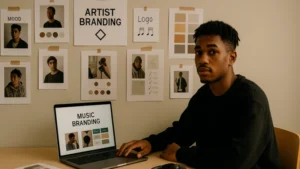
What Is a Visual Brand in Music?
Your visual brand is the look and feel that surrounds your sound. It’s the colors, fonts, outfits, photography style, logos, videos, and content that all work together to communicate:
- Your genre
- Your story
- Your personality
- The world your music lives in
Artists like Tyler, The Creator, Billie Eilish, or Travis Scott all have distinct sounds — but what makes them unforgettable is how they build a world around their music.
Step 1: Define Your Artistic Branding
Before you jump into color palettes and logos, you need to get clear on who you are as an artist.
Ask yourself:
- What emotions do I want people to feel when they hear my music?
- What themes show up often in my lyrics or vibe?
- Who are artists that inspire my sound and visuals?
- What kind of universe does my music live in — gritty, dreamy, raw, polished, dark, colorful?
This step is about creating a core identity that everything else will reflect.
Pro Tip: Create a private Pinterest board or moodboard with references — music videos, fashion looks, album art, colors, textures, even film stills — that visually match your vibe.
Step 2: Choose Your Core Visual Elements
Once you know your identity, it’s time to translate it visually.
Here’s what to define:
Color Palette
Stick to 2–4 main colors.
Example:
- Dreamy R&B? Use soft purples, blues, pinks.
- Aggressive trap? Dark reds, blacks, metallics.
- Alt/Indie? Earth tones, beige, burnt orange.
Fonts / Typography
Use 1–2 fonts across all content — covers, videos, website, etc.
Pick something that reflects your genre and tone.
Photography Style
Decide on a style for your press shots and social content.
Moody and cinematic? Gritty and street-level? Bright and editorial?
Reference tip: Think of your favorite album trailers or Spotify Canvas clips — what kind of world are they building?
Step 3: Align Your Wardrobe and Image
Your style and clothing are part of the artist branding.
You don’t need to be a fashion icon — but consistency helps.
Ask:
- What do I always wear in shoots or videos?
- Do I have signature pieces, colors, or accessories?
- What kind of outfit says “this is me”?
Artists like Steve Lacy or Ice Spice are instantly recognizable — not just by sound, but by style.
Here’s where most artists lose the thread: inconsistency.
If your Spotify cover is dark and cinematic, but your Instagram is full of unedited selfies and meme reposts… the vibe gets lost.
Apply your visual brand across:
- Social media content (color, captions, edits)
- Spotify and DSP visuals (canvas, covers, profile image)
- YouTube thumbnails
- Music videos and short-form content
- Website or Linktree pages
- Merch design
It should all feel like it’s coming from the same world — your world.
Step 5: Organize Your Artist Branding Assets
Save yourself time later by keeping your brand assets in a folder.
Include:
- Your logo (if you have one)
- Color codes (HEX/RGB values)
- Fonts used
- Reference images
- Photoshop or Canva templates for artwork
- Your press kit
This way, every time you drop a new song, shoot a visual, or collab with someone — the artist branding stays sharp.
Final Tip: Evolve Without Losing the Core
Your sound will evolve.
Your visuals should too.
But your core identity should always be felt — even if the surface changes.
Think of it like Kanye: “College Dropout” Kanye looks nothing like “Yeezus” Kanye… but the energy and intent are still there.
Your brand should grow with you — but never confuse your audience about who you are.
Final Thoughts
A strong artist branding isn’t just about aesthetics.
It’s about amplifying your music’s message — before they even hit play.
If you want to build a long-term fanbase, get playlisted, land gigs, or stand out online…
You need more than just fire songs.
You need a visual identity that says:
“This is me. This is my sound. Welcome to my world.”
Need help building your music brand?
We help artists create branding that connects — from visual strategy to cover art and rollout design.
Get in touch